LWW Logo                      Loudoun Watershed Watch

Loudoun Watershed Watch
Overseeing the Water Resources of Loudoun County, VA


Habitat Indicators

Stream habitat includes rocks and sediment substrate on stream bottoms, plants in and around streams, root wades in stream banks, and leaf litter and other organic materials used for food in streams. Aquatic insects are found in greatest numbers in streams that provide good substrate, food, and dissolved oxygen.
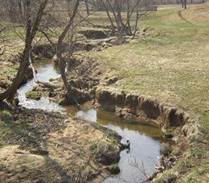
Degrading Impacts -- Stream habitat is degraded by unstable conditions, and that monitoring can provide measures of habitat health. Factors that cause stress to stream habitats include stream bank erosion, sediments covering the stream bottom, and loss of trees in the riparian buffer. Stream habitats are also degraded by changes in water flow that upset a stream's energy equilibrium and cause bank erosion. A natural and balanced stream habitat is needed to preserve a diverse and balanced biological community. No riparian buffer and erosion along Jack's Run
No riparian buffer and erosion along Jack's Run
Assessment Factors -- Habitat conditions are an important indicator of stream health because aquatic insects and fish have specific habitat requirements. The habitat assessment used by DEQ and citizen groups is based upon EPA's Rapid Habitat Assessment Form (1997) which measures the following in-stream characteristics:
  • Pools, riffles, and runs including availability of attachment sites for macroinvertebrates;
  • Composition of bottom substrates including the amount of embeddedness and sediment deposition;
  • Channel alteration and the amount of flow in the channel; and
  • Condition of stream banks including the amount of bank vegetation protection and riparian vegetative zone protection.
Horsepen Run in Cascades


Panther Skin Creek
Panther Skin Creek


         info@loudounwatershedwatch.org     Copyright © 2011 Loudoun Watershed Watch